Project: Visualizing Supply Demand matching Scheduling applications
Description
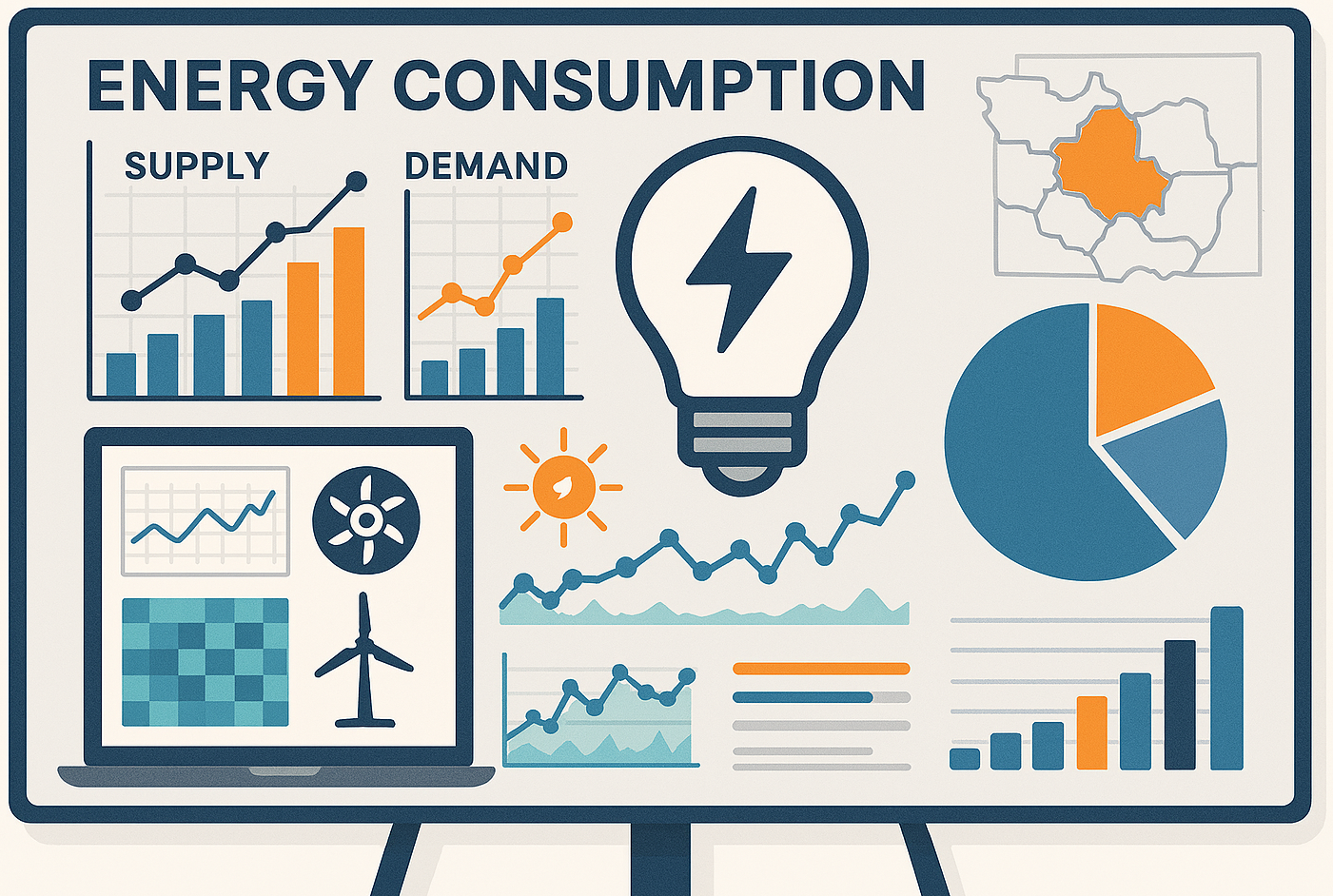
The field of scheduling is a popular topic across many domains. In logistics, companies want to ensure that enough products are produced and delivered on time. In healthcare, hospitals have to ensure that there is enough capacity available to handle unforeseen sick waves, but also in energy, energy consumption and production need to be in balance to avoid power outages, etc.
A common technique for scheduling resources is through supply and demand matching [1,2,3].
In the domain of energy, the goal is to ensure that all energy-demanding devices receive the cheapest energy supplies (e.g., PV) while trying to avoid wasting any green energy sources. The challenge, however, begins when batteries are involved in the equation, enabling assets to use energy that has been stored in the past. The result of such an algorithm is typically a collection of allocations. E.g.:
Demand building X at 10:00 of amount Y was satisfied using the
- Supply solar 10:00 of amount Z +
- Supply battery 09:45 of amount T
- Etc.
Scheduling algorithms often consider larger time periods involving multiple assets. A full simulation of a year for an environment with 2 demanding and supplying entities easily ends up in > 1000 allocations. For designers of scheduling algorithms, gaining insight into these allocations is very important to spot any bugs or undesired behavior in the computed schedules. Dynamic behavior of these demands and supplies (i.e., they can vary over time), makes it very difficult to solve this problem using solely automated techniques.
Research question:
The central research question is: "Given a collection of demands, supplies, and energy price data, how can we use Visual Analytics to gain insight into the supply-demand matching behavior of a scheduling algorithm?' This question comprises two dimensions:
- How can we visualize battery interactions over time to understand why the algorithm has made certain decisions?
- How can we visualize repeating allocation patterns over larger periods in time?
Interesting articles:
[1] https://link.springer.com/article/10.1007/s10586-011-0172-9
[2] https://www.mdpi.com/2079-9292/12/12/2721
[3] https://www.sciencedirect.com/science/article/pii/S2352484721010489
Background:
Many companies in the Netherlands suffer from net congestion in the electricity grid. Everyone wants to use energy at the same time, and the grid is not capable of delivering all this energy due to limitations of the physical wires. Companies, however, still want to grow and try to avoid these “rush hours” as much as possible.
As a result, companies want to better investigate how they can use energy from alternative sources (such as solar panels) or maybe use energy at other moments in time so that they become less dependent on the main grid. In order to achieve this, they typically use an Energy Management System.
An Energy management system enables companies to:
- Analyze the energy consumption and production of their assets.
- Make predictions about their consumption/production based on an ML model of the assets and external information such as weather information and energy pricing; and
- Control assets according to these predictions (e.g., “I see that in the next 24 hours it is colder than usual, so my heatpump will consume more than usual and I need to get this energy from somewhere (either by turning off other devices or installing more solar panels/wind mills, etc.)”)
The Data:
The data that we are working with for these projects are typically timeseries data from various sources (weather, sensors, energy prices) etc.
In order for an EMS system to control assets, the following steps are necessary:
- Read current consumption.
- Predict consumption of the next 24 hours.
- Make decisions based on this information.
EMS software enables this by calculating energy consumption and production estimates for each asset every 15 minutes based on historical data and machine learning/AI models. Armed with this data, the software can make decisions regarding asset management, such as adjusting settings, activating additional power sources, and more, in order to achieve specific business objectives like minimizing network congestion, reducing CO2 emissions, and cutting costs. By pre-computing these steps for the next 10 years, companies can get an estimation of how their environment will work in the future (also referred to as a simulation).
Details
- Supervisor
-
 Bram Cappers
- Secondary supervisor
-
 Fernando Paulovich