Project: The Effect of Imprecise Vector Fields on Trajectory-Based Visualization Techniques
Description
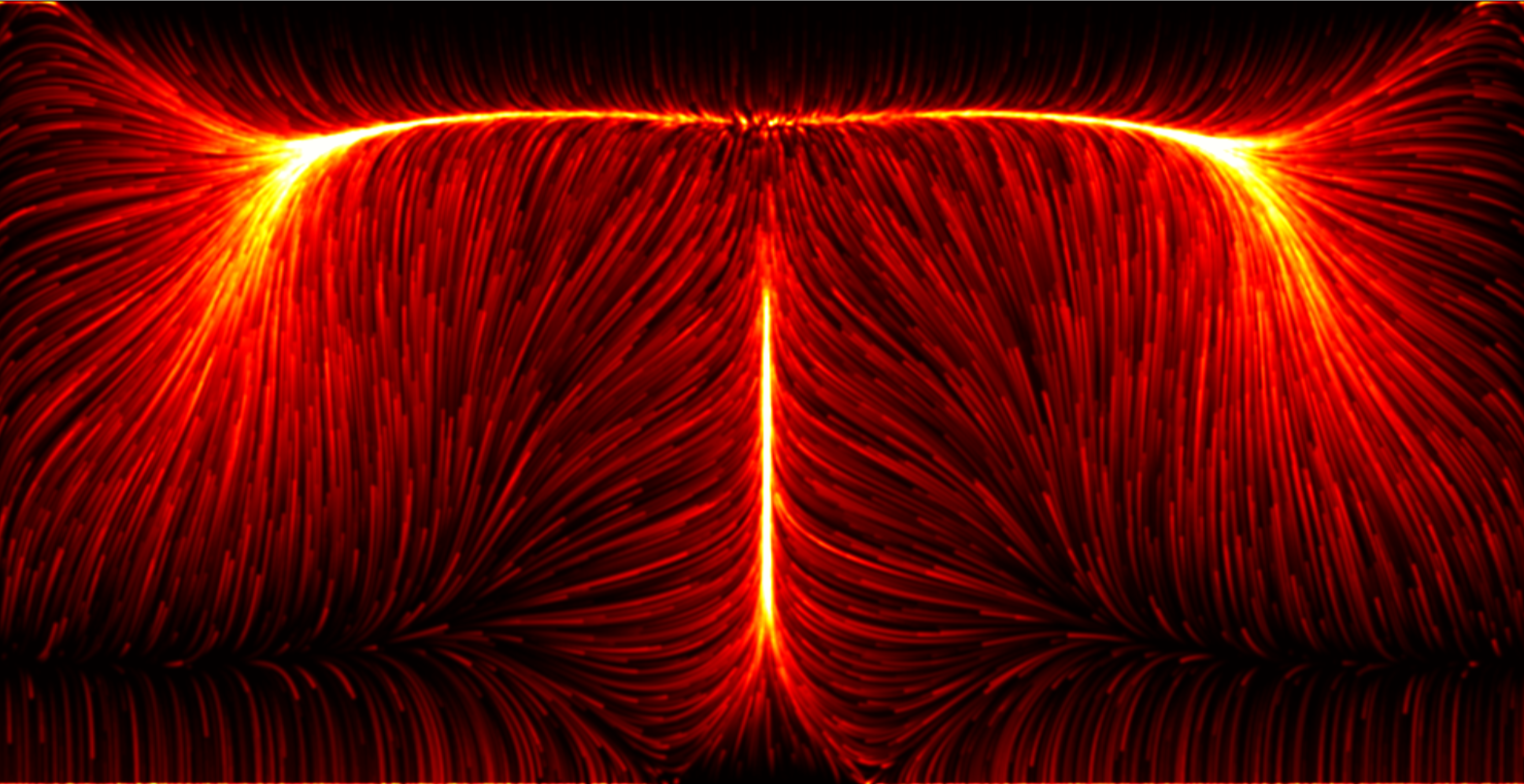
Given a vector field describing the movement of material such as fluid flow, one can visualize properties of the field directly, such as direction and magnitude, or properties of trajectories derived from it, such as average speed along a path [1]. Trajectory-based visualization techniques have gained increasing relevance, as trajectory information reveal structures that are not visible in an instantaneous snapshot of the field.
However, real-world datasets often contain inaccuracies: discretization errors, measurement noise, or sparse sampling. While the effect of these errors is limited for instantaneous views of the vectorfield, they compound for computed trajectories and, as a result, affect the visualizations produced from trajectories. The relationship between error and visual output is not straightforward. Small errors may completely redirect trajectories in certain regions, while larger errors elsewhere have little visible effect on the final image. How these inaccuracies affect trajectory-based visualizations is largely unknown.
The central question of this project is: What is the effect of error in a vector field on subsequent trajectory-based visualization techniques?
Several related questions can be investigated:
- Which existing Lagrangian visualization techniques are most resilient to unreliable data?
- Which type of error (noise, discretization, or sparse data) has the greatest visual impact?
- Where does unreliability affect the visualization more or less? (e.g., near saddle points or coherent structures?)
- Can uncertainty be shown visually as part of the visualization?
The goal of this project is to explore these effects by running experiments with downsampled, sparse, or noisy vector fields, and to study how different kinds of inaccuracies change what the visualization shows. The project is open to adaptation based on your interests. See [2] for a survey of existing Lagrangian visualization techniques.
- Mancho et al. (2013). Lagrangian descriptors: A method for revealing phase space structures of general time dependent dynamical systems. Communications in Nonlinear Science and Numerical Simulation, 18(12), 3530–3557. https://doi.org/10.1016/j.cnsns.2013.05.002
- Balasuriya et al. (2018). Generalized Lagrangian coherent structures. Physica D: Nonlinear Phenomena, 372, 31–51. [https://doi.org/10.1016/j.physd.2018.01.011
Details
- Supervisor
-
 Besm Osman
- Secondary supervisor
-
 Andrei Jalba
- Interested?
- Get in contact