Project: 3D Visualization of Flow Transport Structures
Description
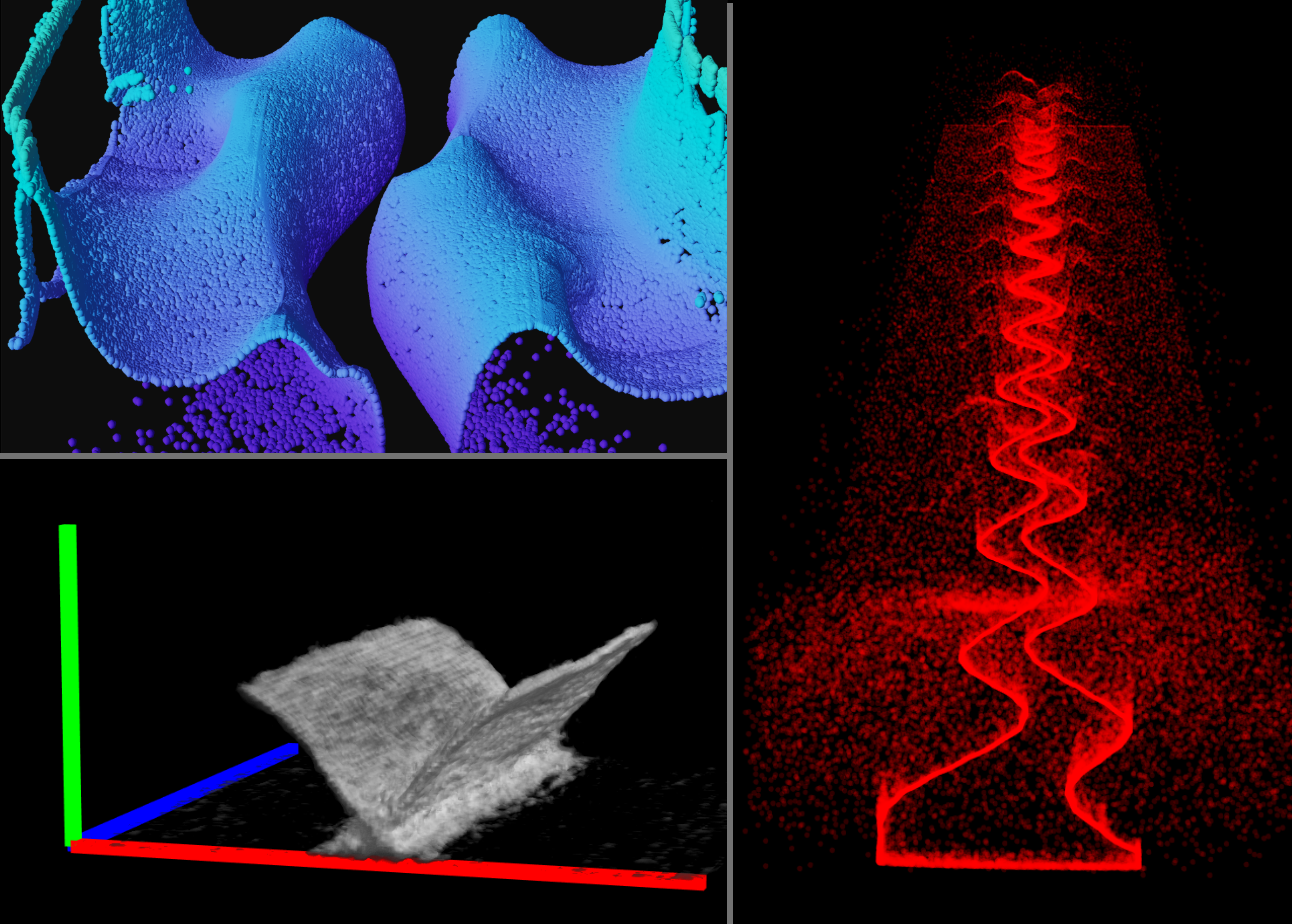
Given a vector field describing the movement of material such as a fluid velocity field, one can visualize properties of the field directly, such as direction and magnitude (Eulerian view), or properties of trajectories derived from it (Lagrangian view). Trajectory-based visualization techniques have gained increasing relevance, as they reveal underlying transport structures that are not visible in an instantaneous snapshot of the field. For instance, Lagrangian methods can identify regions that attract nearby material or act as barriers to transport. However, as these structures move and evolve over time, capturing their behaviour is a challenge even in 2D.
The central question of this project is: How can we effectively visualize the time-evolution of 2D Lagrangian transport structures by rendering them in 3D space-time?
By treating time as a third spatial dimension, the evolution of 2D transport structures can be captured as 3D surfaces or volumes and rendered directly. The goal of this project is to extract these structures using existing Lagrangian techniques (see Balasuriya et al. 2018 for a survey) and visualize them in 3D space-time. This can be approached in several ways, for instance:
- Extracting 2D structures along ridges in scalar fields such as FTLE, and rendering them as curved 3D surfaces in space-time [1] or using a particle based approach [2]
- Using marching cubes to extract isosurfaces of transport properties
- Using volume rendering to show regions with certain transport characteristics
These are just some potential ideas. You are encouraged to adapt the project to your own interests and ideas, as long as the visualization is 3D, the structures are Lagrangian, and the result gives meaningful insight into the transport behaviour. Focus can be on the identification of structures, rendering or both. Feel free to get in touch if you have questions or are interested in this project.
References
- Sadlo et al. (2013). Space-time flow visualization of dynamics in 2D Lagrangian coherent structures. In Computer Vision, Imaging and Computer Graphics: Theory and Application (pp. 145–159). Springer. https://doi.org/10.1007/978-3-642-38241-3_10
- Stelter et al. (2025). A particle-based approach to extract dynamic 3D FTLE ridge geometry. Computer Graphics Forum, 44(1), e15203. https://doi.org/10.1111/cgf.15203
- Balasuriya et al. (2018). Generalized Lagrangian coherent structures. Physica D: Nonlinear Phenomena, 372, 31–51. https://doi.org/10.1016/j.physd.2018.01.011
Details
- Supervisor
-
 Besm Osman
- Secondary supervisor
-
 Andrei Jalba
- Interested?
- Get in contact