Project: Visual Analytics for Historical Demographics.
Description
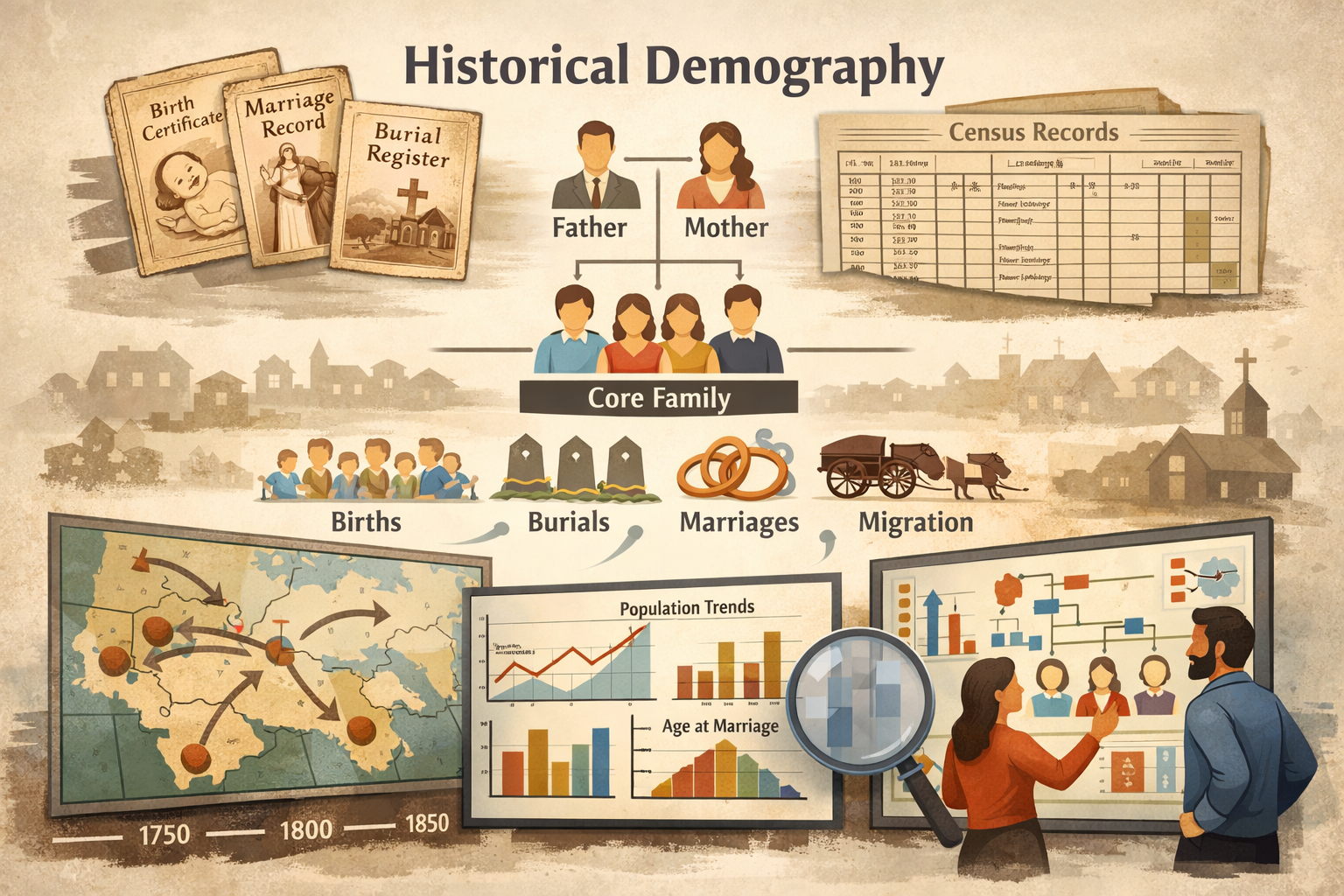
Historical demographic research depends on archival sources such as birth records, marriage records, burial records, and census documents. These materials span long time periods and large geographic areas, and may be inconsistent, incomplete, and difficult to compare. Also for this data to be useful for demographics, individuals must be identified across records in a process called record linkage. Record linkage solves the issue that he same person may appear with varying spellings, missing attributes, or contradictory information in different records, making it unclear which entries refer to that person or that person's family.
In this project record linkage should lead to so‑called core families: father, mother, and their children. Based on that data, demographics like birth counts, death counts, marriage timing, family size, and spatial movement can be computed for time periods and geographical areas. These demographics could then be used in a visual analytics tool to do pattern recognition, anomaly detection, and comparative exploration across regions and time periods, helping researchers identify long‑term trends, local irregularities, and structural changes in historical populations.
Details
- Supervisor
-
 Huub van de Wetering
- Interested?
- Get in contact