Project: Visual Editor for Digital Twin Construction
Description
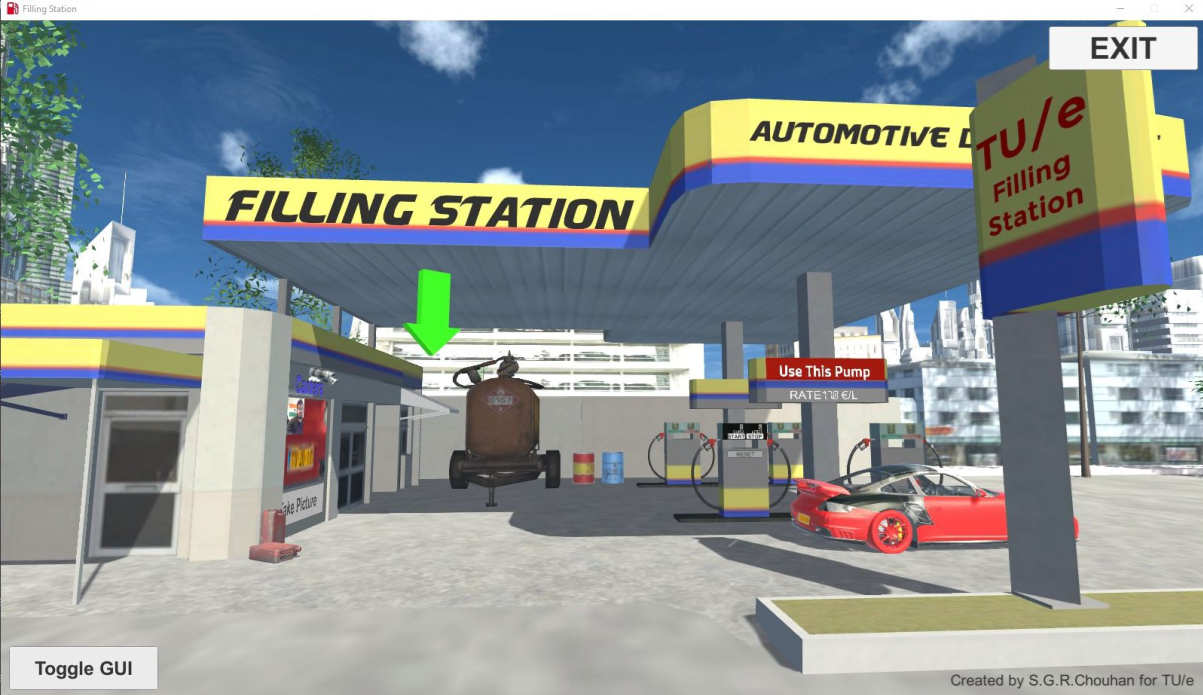
Developing Digital Twins often requires integrating multiple technologies, simulation models, data sources, communication services, and visualization tools. This process is typically complex and requires significant programming effort. Inspired by visual engineering environments such as AVS, LabVIEW, and Node-RED, this project aims to simplify Digital Twin development through a graphical composition environment.
Project Objective
The goal of this project is to develop a Visual Digital Twin Editor that allows users to construct Digital Twins by connecting reusable modules on a graphical canvas.
The editor should provide a drag-and-drop environment where Digital Twin modules can be placed, configured, and connected through graphical ports and connectors. Similar to AVS, the canvas will allow users to create Digital Twin workflows by linking modules representing sensors, simulations, AI services, databases, communication interfaces, and 3D visualization components.
The resulting Digital Twin architecture should be automatically translated into an executable Digital Twin configuration and visualized in a 3D environment.
Student Tasks
The student will:
• Study existing visual composition environments (AVS, Node-RED, LabVIEW, Simulink).
• Design a meta-model for Digital Twin modules and connections.
• Develop the graphical canvas and connection mechanisms.
• Implement a prototype Visual Digital Twin Editor.
• Demonstrate the editor using a realistic Digital Twin case study.
Expected Profile
The student should have a strong background in Software Engineering and preferably experience with:
• Object-Oriented Design
• Software Architecture
• Model-Driven Engineering
• Web-based User Interfaces
• Java, C#, TypeScript, or similar programming languages
Expected Results
The project will deliver a prototype Visual Digital Twin Editor, a reusable module framework, and a demonstration showing how Digital Twins can be created visually through module composition rather than traditional programming. This work contributes to the development of low-code Digital Twin Engineering environments and builds upon the Digital Twin abstraction framework proposed for Virtual Components.
Details
- Supervisor
-
 Huub van de Wetering
- Secondary supervisor
-
IBIon Barosan
- Interested?
- Get in contact