Project: Interactive Brain-Shift Correction for Neuronavigation
Description
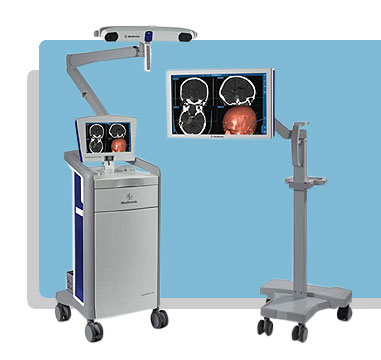
Neuronavigation systems let surgeons track instrument position relative to preoperative MRI, achieving roughly 1 mm accuracy before the skull is opened. Once surgery begins, however, the brain deforms — sometimes by more than a centimeter — and this "brain shift" progressively degrades navigation accuracy, particularly in depth, undermining the reliability of the preoperative map exactly when precision matters most. This project addresses that gap by building an interactive correction tool: using a Medtronic Stealth S8 neuronavigation system, a tracked pointer, and a phantom head with matching MRI, the student(s) will let a surgeon manually correct for brain shift by selecting corresponding points on the exposed tumor edge and the MRI, then compute a nonlinear deformation to re-align the MRI with observed anatomy.
The resulting prototype could display MRI data in both 2D slices and 3D renderings, show the real-time tracked pointer position, support interactive point selection, and update the visualization live using a nonlinear point-based registration method (e.g. thin-plate splines). The approach will be validated on the TU/e Stealth S8 phantom setup and tested retrospectively on pre-/post-operative MRI cases to assess registration accuracy.
Details
- Supervisor
-
 Maxime Chamberland
- Secondary supervisor
-
 Rembrandt Bakker
- Interested?
- Get in contact