Project: Coordinated Projections: A New Approach to Multi-Faceted Process Exploration
Description
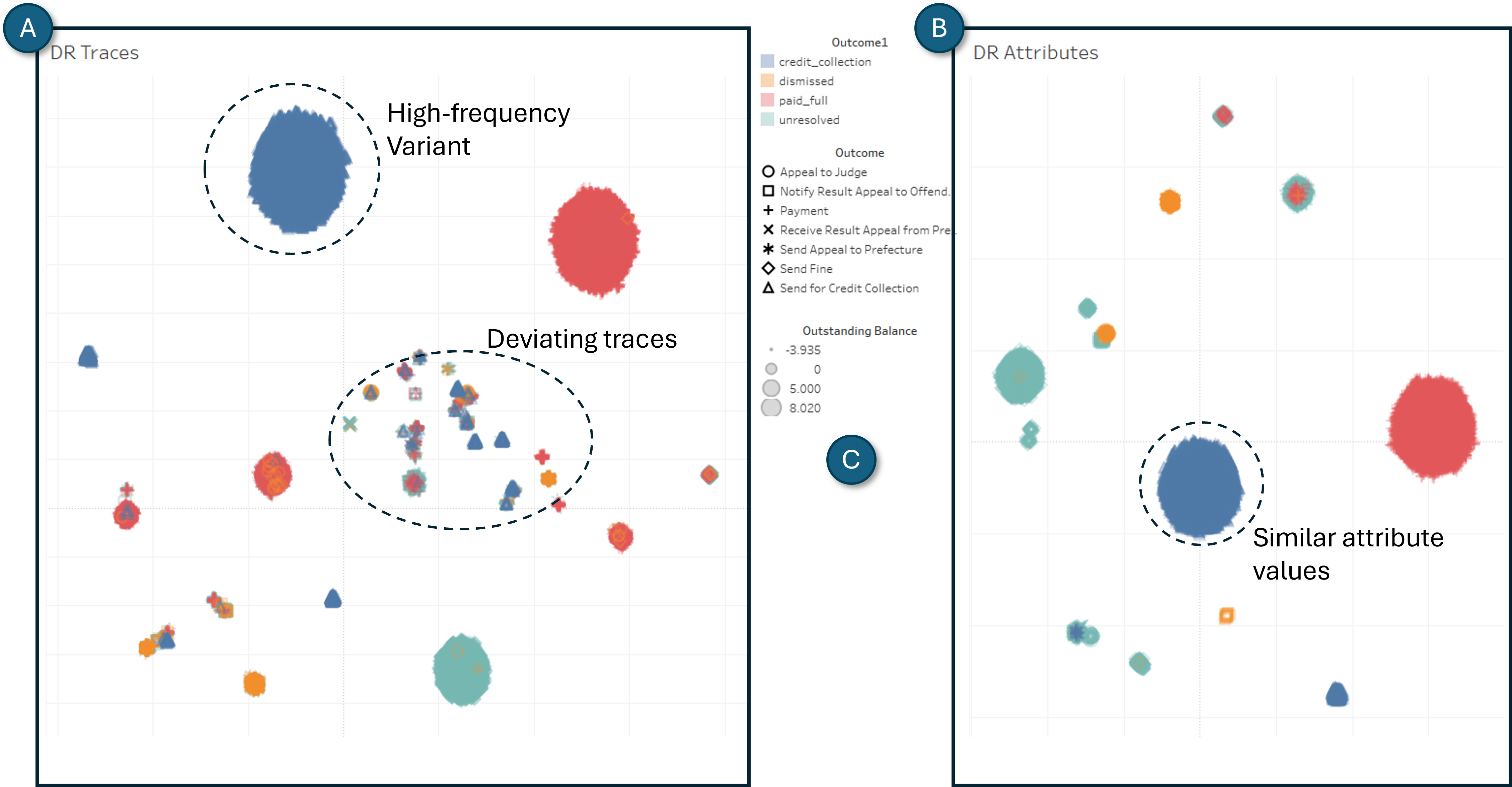
Process exploration is a central task in process mining, enabling analysts to discover patterns, identify inefficiencies, and generate hypotheses from event log data. Traditional process mining approaches primarily rely on static control-flow visualizations, such as Directly-Follows Graphs (DFGs), which represent only a single perspective of the process. While effective for understanding process structure, these visualizations often fail to capture the rich multi-dimensional nature of real-world event logs, including temporal, organizational, semantic, and behavioral aspects.
Recent advances
in visual analytics and machine learning provide opportunities to explore
process data from multiple coordinated perspectives. Techniques such as
dimensionality reduction (e.g., UMAP and t-SNE), and interactive linked
visualizations can reveal hidden structures and relationships across different
process facets. Building on recent work presented at the ICPM 2025 EdbA Workshop
by Van den Elzen et. al, this project investigates how coordinated projections
can support richer and more flexible process exploration.
Focus of the Project
This project
focuses on designing and evaluating a visual analytics system for multi-faceted
process exploration using coordinated projections. The central idea is to
generate multiple linked low-dimensional representations of process data, where
each projection captures a different perspective or facet of the event log.
The project may
involve:
- Applying dimensionality reduction techniques to
process-related feature spaces.
- Combining topic modeling or embedding techniques with
process mining data.
- Designing coordinated views that support
brushing-and-linking across perspectives.
- Developing glyph-based or density-based representations
for process instances.
- Exploring how analysts can correlate structures across
multiple process facets.
A prototype system will be developed and evaluated using real-world event log datasets, such as traffic fines or healthcare processes. The project aims to contribute new interaction and visualization techniques for exploratory process mining and to better support hypothesis generation and analytical reasoning in complex process datasets.
The project is expected to last 6 months, and at the end, the
student should deliver a report describing the work performed, the methodology
used, and corresponding findings. It is expected that the results can be used
in a scientific journal publication.
Requirements:
- Good programming skills
- Visualization knowledge on design-centered approach (e.g., Munzner)
- Ability to use and apply ML models
Detailed description
View PDFDetails
- Supervisor
-
 Stef van den Elzen
- Interested?
- Get in contact